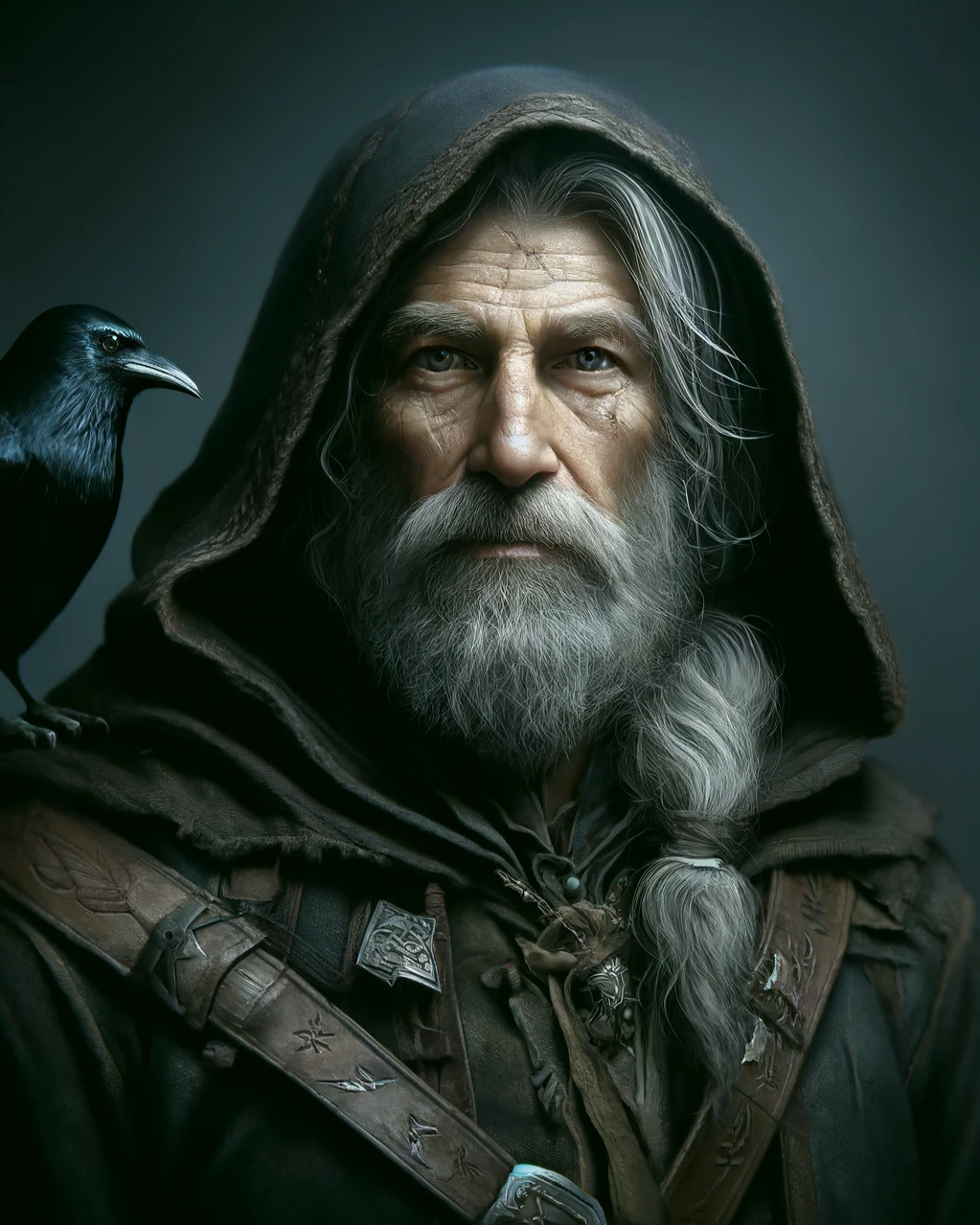
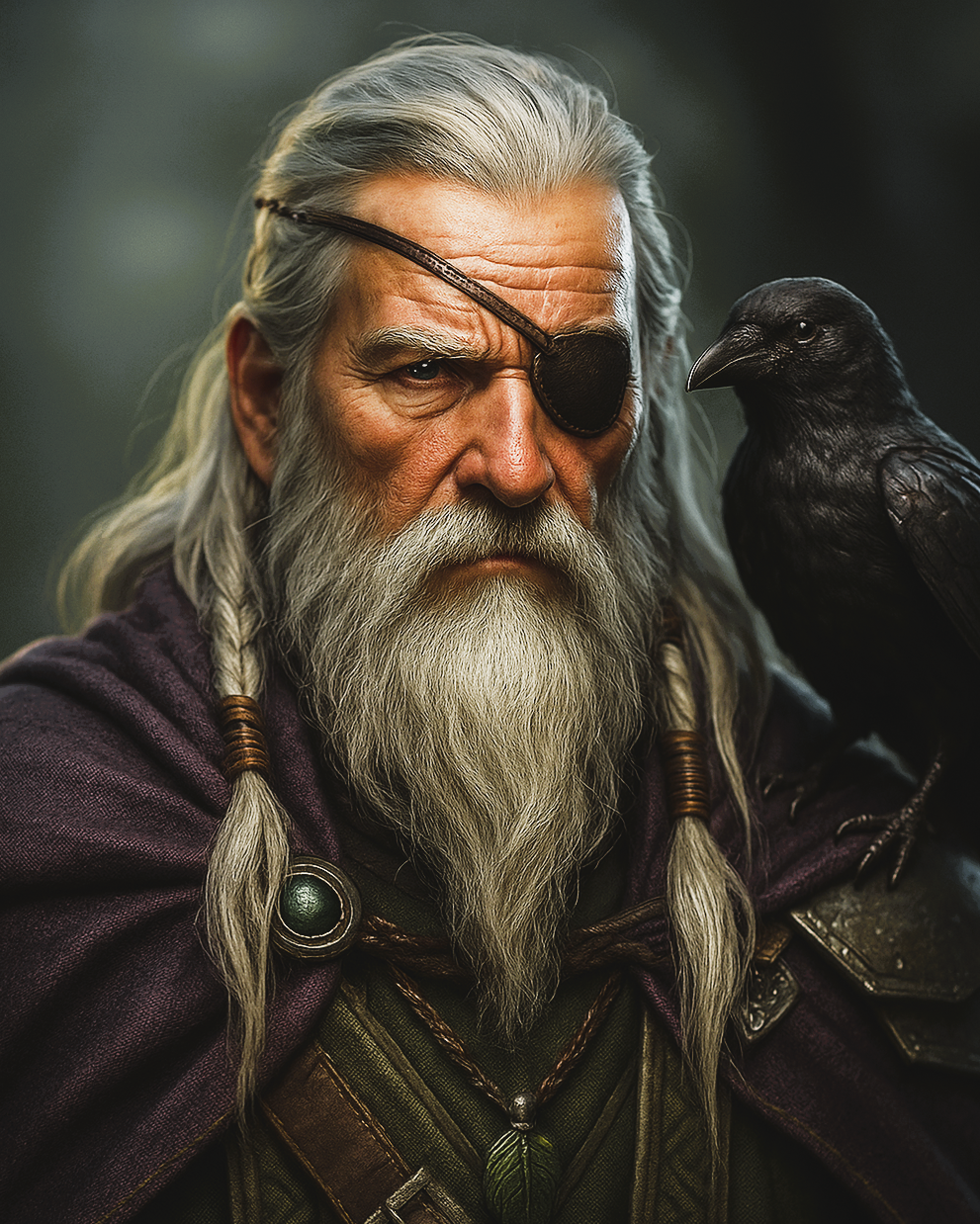
Odin, the All-Father, disguised as an elven druid and sage of the Shimmerwood for over 300 years
Founded the Order of Seasons — an alliance of champions from each seasonal Fey Court — to fight Nidhogg’s undead legions
Known as the Knight of Ravens, he led the Order into battle and wove a portion of his divine essence into the leyline barrier to seal Nidhogg in the Shadowfell
His power is the lock on Nidhogg’s prison — the elven leyline barrier is the cage, but Vidrir’s divine energy holds the door shut
Cannot leave the mortal realm without the seal collapsing — he has been trapped here for centuries, his divine power slowly draining as the barrier weakens
Close friend of Lerissa, trusted mentor to the party, and listed among the Cult of the Eclipse’s enemies as “Knight of Ravens, ancient foe of darkness”
Vidrir presents himself as a reclusive elven druid living in a protected grove deep in the Shimmerwood, beneath a great oak where he meditates
His grove has undead wards — Francis the Flameskull was repelled upon approach, revealing the grove’s hidden protections
His ravens patrol the Shimmerwood, identifiable by violet markings — his familiar is named Huginn, after the raven of Norse myth
He is a close friend of Lerissa, the tiefling barkeep of the Raven’s Perch Tavern in Tannis — he loves her ale, and she knows more about his history than she lets on
He told the party that he and Lerissa “have gone on several adventures together and she is as good with a bow as she is brewing ale”
His disguise is built on truth: his friendship, his knowledge, his concern for the realm — all genuine, with only his divine identity omitted
When Nidhogg’s undead legions threatened to drown the Feywild in shadow, Vidrir came to the Fey Courts and proposed an alliance — one champion from each season, united in purpose
The Order’s captain was Sir Eirik, Champion of the Summer Court and wielder of Summer’s Edge
They could not destroy Nidhogg — even gods lacked the power to unmake an ancient shadow dragon — so they wounded him enough to make binding possible
Most of the Order’s members died buying time for the seal to be completed — their sacrifice bought the realm centuries of peace
The Order’s tomb lies north of the Shimmerwood, across the Misty Run River — covered in vine, floral, and raven motifs, it is where the party’s campaign began in Session 1
The tomb’s oath inscription reads: “We of the Order of Seasons, vow to fight darkness wherever it is found”
Vidrir wove a portion of his divine essence into the leyline barrier the elven mages constructed — his power serves as the anchor and lock
The barrier is maintained by four leyline temples, one in each seasonal domain, while Vidrir’s divine energy ensures the door stays shut
He describes it as “holding a door shut while something pounds against it from the other side” — as the elven barrier weakens, more weight falls on his shoulders
He cannot leave, cannot fully restore himself, and cannot reveal his true form without risking everything — the disguise itself conserves power
If the seal breaks, Nidhogg escapes with centuries of rage and cult allies, and Vidrir may lose his invested power permanently — stranded and diminished, possibly forever
The only paths to his freedom: the party strengthens the barrier enough for him to withdraw his power, or Nidhogg is destroyed entirely
Lerissa directed the party to seek Vidrir after the darkness fell on Tannis, suggesting they bring a cask of her ale as a goodwill offering
Vidrir identified Summer’s Edge from its broken pieces and analyzed the Cult of the Eclipse medallion’s tracking spell
When he held the broken sword, it stirred to life in his hands — his hair stood on end and a warm smile washed over his face, as if the blade remembered him
He told the party that weapons sometimes have “souls” that may react to other living things — hinting at the blade’s sentience without revealing his connection
He made the party promise to return when the sword was reforged so he could see it whole again
He grew deeply alarmed when learning Serenity had contacted Nidhogg through a seeing stone — his “cryptic remarks hinted he may have personally fought in that war”
He gave the party his personal Order of Seasons medallion — a symbolic passing of the torch that granted them safe passage to the Fey Courts and audiences with their rulers
Shadicar researched the Order of Seasons at the Chained Library and discovered that Vidrir was the Knight of Ravens, leader of the Order, and over 300 years old
When the party returned with the reforged Summer’s Edge, Vidrir was “genuinely touched by the gifts — and visibly stirred to see the sword restored”
As he took the blade in his hands, its truth-seeing light peeled away his glamour — his beard lengthened, his frame grew “leaner and older, not frail — but timeless,” and a single eye glimmered with ancient wisdom while the other was gone, covered by a simple eye patch
He spoke to the blade like an old friend: “No, there’s nothing to forgive, bright one. I know it’s just your nature. It does me well to see you again”
He then awakened Summer’s Edge to its exalted state, granting it the ability to bestow limited truesight — critical for fighting the Weaver, whose power relies on illusion
He revealed his familiar’s name as Huginn and showed that he had sheltered Skreek’s squires at the grove — his ravens had found and escorted them to safety
Vidrir cannot fight the party’s battles — his power is committed to maintaining the seal, and direct divine intervention would invite divine retaliation that would escalate beyond mortal capacity
He believes mortals possess a unique agency his power cannot emulate: the freedom to act, to change the course of the world, and to inspire others to do the same
He guided the party without forcing their choices: “Have I hoped you would grow strong enough to face what’s coming? Absolutely. But manipulation implies I forced your choices. Every step of your journey has been yours”
His investment in the party is personal, not just strategic: “When I offered you tea, shared stories, laughed at your jokes — those were not performances. You matter to me”
The Weaver executed his summoning ritual at the ancient battlefield where Vidrir led the Order of Seasons centuries ago
The party stopped the ritual; Trius killed the Weaver with Moonbeam before Nidhogg could break through. Nidhogg remains sealed.
This is the first step toward Vidrir’s freedom — the active threat to the barrier has been eliminated — but the barrier itself is still damaged from years of cult sabotage
Vidrir remains bound to the mortal realm until the barrier is repaired enough for him to safely withdraw his divine essence; the party now holds the knowledge from the Chained Library on how to accomplish that
The path forward: locate and repair the damaged leyline temples, close the remaining Hollow Thresholds, and restore the barrier the Order of Seasons built — the work Vidrir has waited over 300 years to see completed